


Properly selected fittings above the bath help ensure reliable operation of the water system and comfortable flow control. The purchase decision requires the equipment variant to be matched to the type of connections (concealed or exposed installation), the flow capacity of the Spout and the body material. The most durable designs are based on Brass that withstands pressure fluctuations. This guide explains how to match the technical parameters of the equipment to the conditions in the bathroom.
Types of Bath mixers
Exposed models are connected directly to the wall outlets for hot and cold water, with a standard centre-to-centre spacing of 150 mm. This installation system avoids extensive work inside the wall and makes future diagnostics and seal replacement considerably easier. Adjustable eccentric connectors allow the installer to compensate for pipe-spacing errors of up to 20 millimetres. The external body also provides quick access to the mixing Cartridge in the event of a fault.
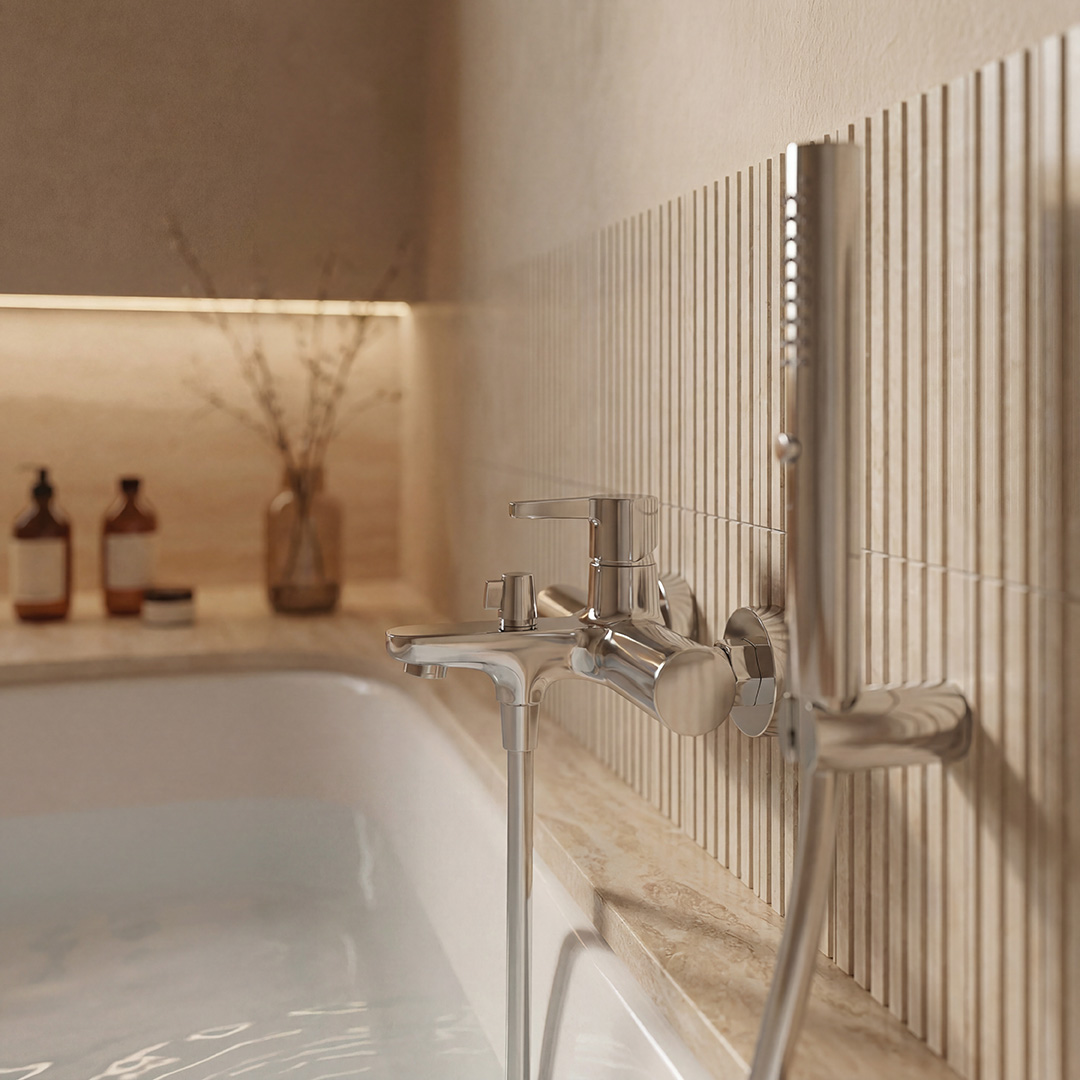
Concealed mixers require the main mixing module to be hidden inside the wall, leaving only the cover plate, handle and Spout visible. The required chasing depth is usually between 50 and 80 mm, so the partition wall must be sufficiently thick. This design minimises the area exposed to soap deposits and makes the bathing zone easier to keep clean. The control module, known as an i-box, must be installed before the waterproofing and ceramic tiles are laid.
Freestanding systems are installed by routing the supply pipes directly through the floor screed layers. The tall body must be firmly secured to the floor with a dedicated mounting base that transfers loads and prevents the structure from wobbling. With this solution, the reach of the Spout must be aimed precisely within the inner outline of the bath to eliminate the risk of water splashing onto the floor.

Multi-hole versions are fitted into accurately cut openings, usually three to five, in the reinforced rim of an acrylic or composite bath. Flexible supply hoses and the shower-hose retraction mechanism remain hidden below the bath surround, improving the appearance of the area. Before purchasing this type of bath mixer, check that the rim of the sanitary acrylic bath is strong enough to withstand the mechanical loads exerted by the substantial Brass body when the lever is operated.
Which bath mixer should you choose?
Thermostatic cartridges automatically mix the water to a preset temperature, usually 38°C, and respond to pressure fluctuations in the system in a fraction of a second. This protects users from sudden bursts of scalding water when outlets in other rooms are used at the same time. Thermostatic mixers work best with domestic hot-water storage tanks. Their mechanisms require regular calibration, while the filter screens must be descaled to maintain full flow capacity.
The resistance of fittings to deterioration depends primarily on the metal alloy used. A market standard offering very high resistance to leaks, promoted among others by the Polish brand Kuchinox, which has its own production lines and extensive testing facilities, is MO59-grade Brass. Dense cast-Brass bodies cope better with thermal stresses. The external Finish is applied by multi-stage electroplating or PVD (Physical Vapour Deposition), in which coatings are deposited in a vacuum. This significantly increases surface hardness and reduces the risk of chipping.
The type of shower diverter determines how the flow is directed between the Spout and the hand-shower set. Pressure-operated mechanisms automatically return the flow to bath filling when the water supply is closed, whereas mechanical versions require manual locking. Ceramic diverters with a positive lock operate reliably in domestic systems with low working pressure, below 2 bar, preventing the valve from dropping during showering.
The type of handle affects how smoothly the flow rate can be adjusted. Flat, wide handles provide better leverage on the ceramic Cartridge, which is useful when the fitting is operated with wet hands. When Bathroom mixers are considered more broadly, the parameters of the Spout itself, including its angle and flow capacity, determine how long it takes to fill the bath completely.
Installing a bath mixer
The position of the water outlets requires strict compliance with dimensional guidelines. Threaded outlets for wall-mounted variants should be placed 10 to 15 centimetres above the planned upper rim of the bath. Failure to maintain this distance may leave insufficient room to operate the shower hose or cause excessive noise as the water hits the bottom of the bath.
Installing components in the floor requires the base module to be perfectly level before it is encased in concrete. An alignment error of only a few millimetres at the connection box can produce a visible deviation from vertical in the tall mixer body. This cannot be corrected after the ceramic floor finish has been laid. All threaded connections should be sealed with anaerobic sealant or plumbing paste and hemp fibres.
Cutting holes in the bath for multi-hole systems requires precise use of a hole saw. Acrylic tends to overheat during drilling, so the work must be carried out at low speed. The components, including the Spout, knobs and pull-out hand shower, should be positioned in the stiffest areas of the structure, away from curves where the material is more likely to crack under dynamic loads.
What else should you check when buying a mixer?
The weight of the product is a direct indication of the thickness of the Brass casting. A heavier construction provides better resistance to water hammer, which is a sudden rise in pipe pressure, and better attenuation of flow noise. Thin-walled zinc-aluminium alloys, known as Zamak, corrode internally much faster and may develop microcracks around threaded connections after several years of use.
The Flow class determines how quickly the bath fills at the standard dynamic pressure of 3 bar. Class S, from 15 to 19.8 l/min, or a higher class is optimal for this type of product. Class Z products, below 9 l/min, are well suited to washbasins because of their lower water use, but filling a bath with such a flow takes a very long time and allows the water to cool.
Fittings should be cleaned with products free from acids and strong abrasive particles, which can damage protective coatings. Hard limescale deposits can be removed safely from the Spout with citric-acid solutions. Regular maintenance of this kind helps extend the leak-tight service life of NBR or EPDM rubber seals used directly in valves and in the moving ball joints of shower hoses.


