


At what height should a hand shower be installed?
At what height should a hand shower be installed to make everyday showering comfortable? The height of the users is not the only factor that matters. You should also consider how the hand shower is mounted, the position of the mixer and the type of bathing area. A shower enclosure requires a different setup from a bath. Read on to learn the recommended installation heights for individual fittings and how to adapt them to your bathroom.
How should the height of a hand shower be adjusted to the users?
A hand shower used as an overhead spray should ideally be positioned about 20–30 cm above the head of the tallest household member. For a person who is 170 cm tall, this means a height of about 190–200 cm. For someone who is 185 cm tall, it will be about 205–215 cm. These are approximate values that should be adjusted to the bracket design and the angle of the hand shower.
This position allows the user to stand comfortably under the water without lowering their head. At the same time, the hand shower should not be so high that removing it from the bracket requires excessive reaching.
If the hand shower is mainly held in the hand to wash the body, the bracket can be installed lower, for example at a height of 150–170 cm. This makes the hand shower easier to reach and allows the water to be directed at a selected part of the body.
When people of different heights use the bathroom, a shower set with an adjustable bracket on a rail is the most practical choice. It allows the hand shower to be moved vertically and, in many models, its angle to be adjusted. This is particularly useful for families with children, as every household member can set the spray at a suitable height.

The needs of older people and users with reduced mobility should also be considered when deciding on the installation height. If a user sits on a shower seat, the hand shower should be within reach without requiring them to stand up. In this situation, an adjustable bracket offers greater flexibility than a single wall-mounted bracket.
At what height should a shower rail be installed?
The upper end of a shower rail is often installed approximately 200 cm above the finished floor. However, this is not a universal dimension. The position of the rail should be adjusted to its length, the bracket design and the users' height so that the hand shower can be set at different levels.
In a typical shower enclosure, a useful reference is an adjustment range of approximately 150–200 cm above the floor. This does not mean that the rail itself must be this long. The adjustment range depends on the length of the guide and the position of the mounting points.
For example, a 70 cm rail with its upper end at a height of 200 cm will extend down to approximately 130 cm above the floor. The actual movement range of the bracket may be shorter because the slider does not always travel along the entire length of the rail.
Before drilling the holes, hold the rail against the wall, place the hand shower in the bracket and check its position at the highest and lowest settings. This will show whether every household member can use the shower without bending down awkwardly or raising their arm too high.
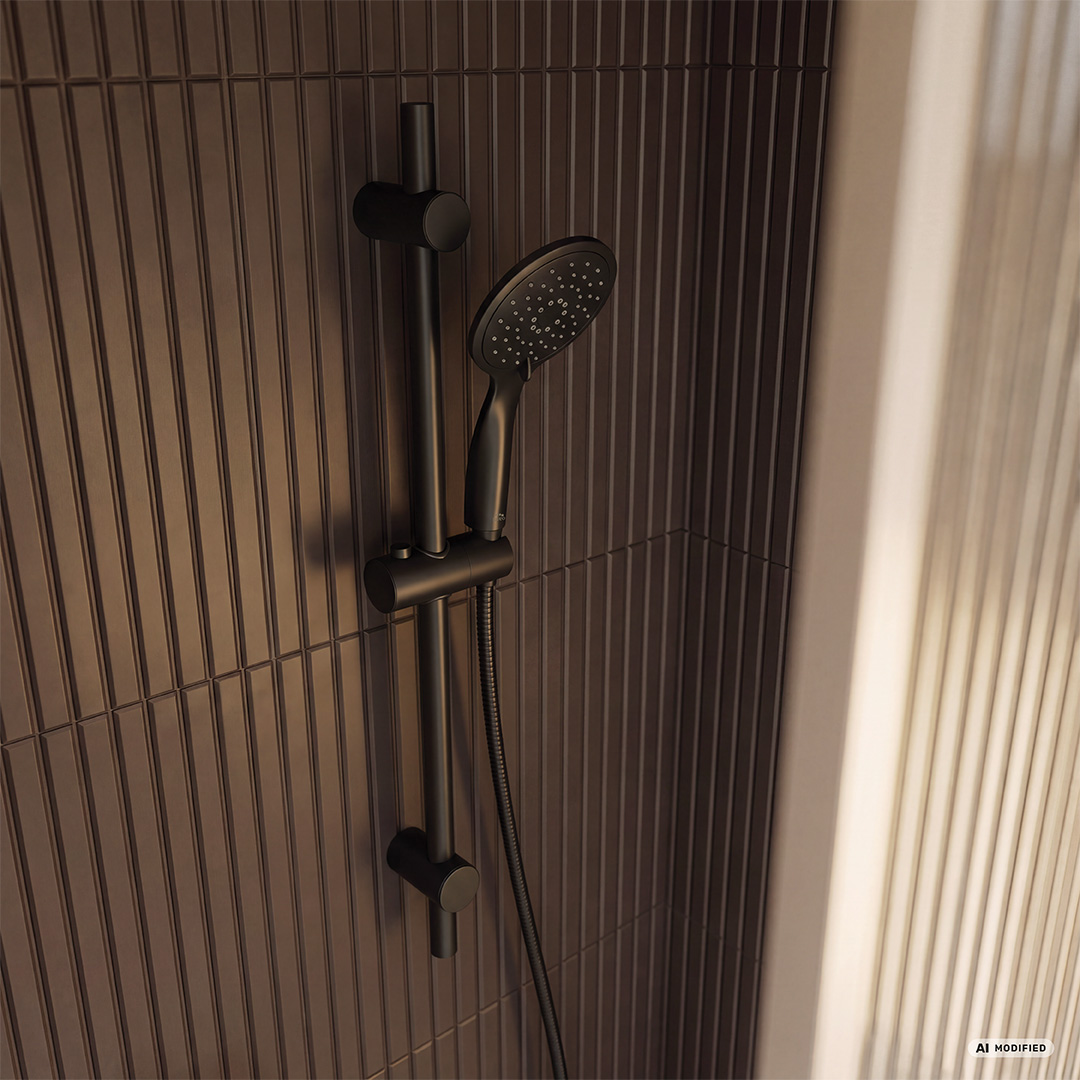
When selecting a shower rail, also consider:
- Bracket adjustment range – the wider it is, the easier it is to adapt the hand shower height to different users.
- Angle adjustment – this allows the water to be directed into the shower enclosure.
- Spacing of the wall fixings – particularly important when replacing a rail and reusing existing holes.
- Slider stability – the bracket should keep the hand shower in the selected position without slipping down on its own.
Bathrooms used by several people benefit from shower sets with a sliding bracket, which are also available from Laveo. Before purchasing a particular model, check its dimensions and adjustment range.
At what height should a shower mixer be installed?
A shower mixer is usually installed 110–130 cm above the finished floor. The most common range of 110–120 cm provides comfortable access to water temperature and flow controls. A higher position may be considered for tall users.
For exposed mixers, the installation height is usually measured to the centreline of the water connections. Their standard centre-to-centre spacing is generally 150 mm, but the specification of the selected product should be checked before installation. In an existing bathroom, the location of the connections may limit height changes unless the plumbing is altered.
A concealed shower mixer, as part of a concealed system, allows the control panel, hand shower connection and overhead rain shower to be positioned separately. Because part of the system is located inside the wall, the layout must be planned before the wall finish is installed. The installation depth specified by the manufacturer for the mixer body must also be observed.
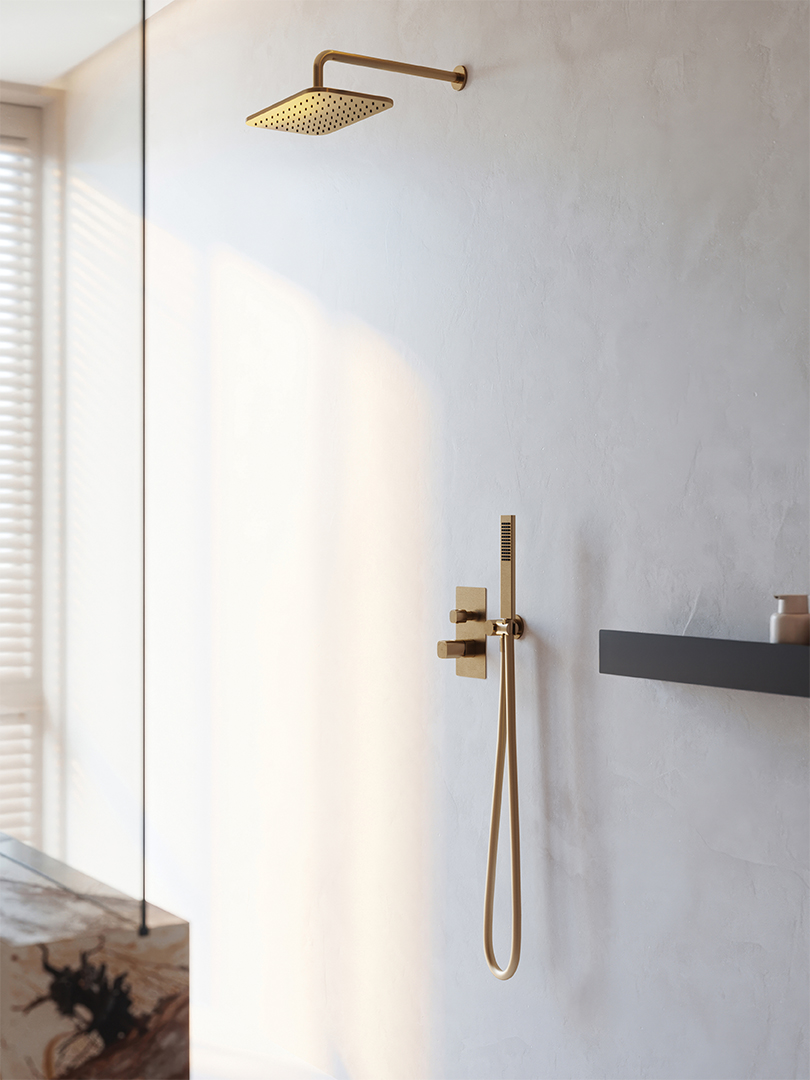
Shower columns, in which the mixer is connected to the overhead rain shower by a pipe, require particular attention. In such a set, the mixer height affects the final position of the upper shower head. Before installation, check the total height of the system rather than relying solely on the standard connection level.
The position of the bathroom mixer should also allow it to be operated comfortably without stepping directly under a stream of cold water. This is particularly important in enclosures where the user turns on the shower before entering.
At what height should an overhead rain shower be installed?
An overhead rain shower is usually installed approximately 200–220 cm above the floor, leaving about 20–30 cm of clearance above the head of the tallest user. If very tall people use the shower, the height can be increased to approximately 230 cm, provided that the set design and room height allow it.
For a person who is 180 cm tall, a suitable starting point is therefore approximately 200–210 cm. The final measurement should refer to the underside of the head from which the water flows, not only to the mounting point of the arm.
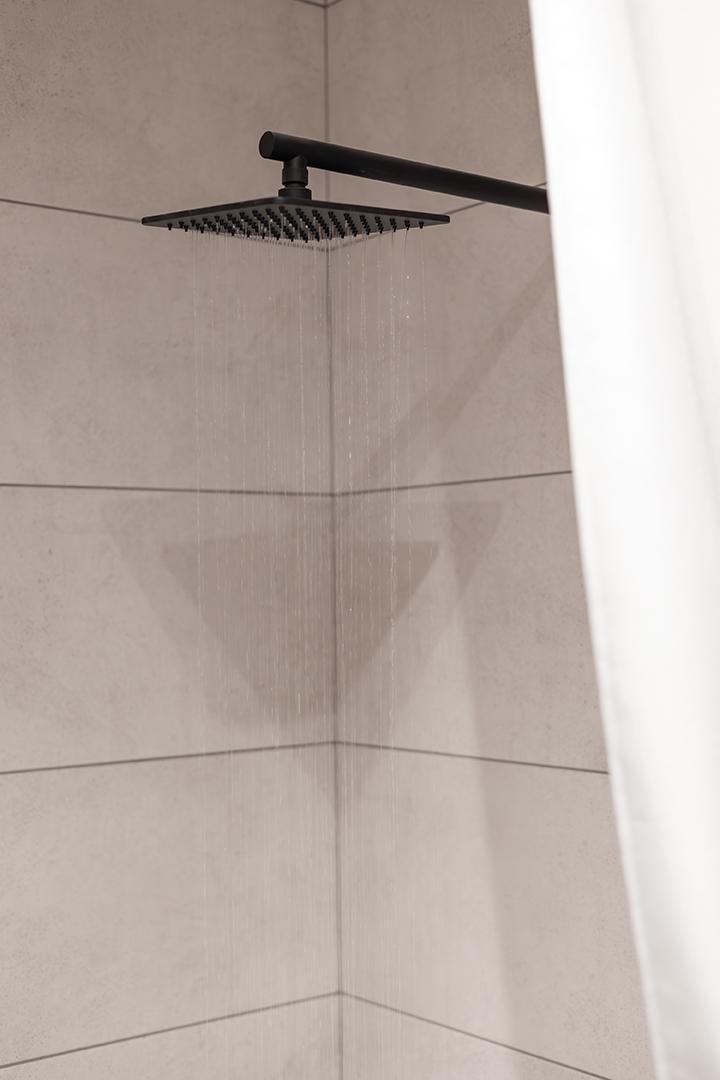
The installation method also matters. Available overhead rain showers can be mounted on the wall or ceiling. A wall-mounted model is fitted to an arm projecting from the wall, so its shape and the distance between the connection and spray face must be considered. With a ceiling-mounted overhead rain shower, the head position depends on the ceiling height and the fixing method.
In exposed systems with a shower column, the height of the overhead rain shower may be fixed or adjustable. Models with a telescopic pipe allow the upper shower head to be moved within the range specified by the manufacturer.
The height of the users should not be the only consideration. An overhead rain shower positioned too high may cause water to splash beyond the shower area, especially in open walk-in enclosures. The size of the bathing area, the reach of the spray and the drain position must therefore also be considered.
If the bathroom has a low ceiling, check the total height of the overhead rain shower, including the arm or column, before purchasing. This prevents a correctly installed set from leaving too little clearance above the user's head.
More advice on the correct height for an overhead rain shower is available in our separate guide to planning its position in the bathing area.
How high should a hand shower be installed above a bath?
If the hand shower is mainly used while bathing, the bracket can be positioned approximately 60–70 cm above the top edge of the bath. This can make it easier to reach the hand shower when washing hair, rinsing the body or cleaning the bath. The final height should nevertheless be adapted to the users and the way the bath is used.

The arrangement is different when the bath also serves as a shower. The hand shower should then be high enough for comfortable use while standing. As in a shower enclosure, when the hand shower is used as an overhead spray, it is advisable to leave approximately 20–30 cm of clearance above the user's head.
The height measured from the bathroom floor must be distinguished from the height measured from the bottom of the bath. A person taking a shower stands on a surface higher than the room floor. A bracket installed at the same height as in a shower enclosure may therefore be too low.
If the bath is used both while seated and as a shower, an adjustable shower rail is the most versatile solution. It allows the hand shower to be set lower for bathing and higher for showering while standing.
For a bath fitted with a bath-shower mixer, the hose length must also be checked. It should allow the hand shower to be used freely throughout the bathing area without straining the connection at the mixer. At the same time, an excessively long hose can get in the way when using the bath.
If the bath also serves as a shower, a bath screen helps prevent water from reaching the floor. Position the hand shower so that the spray is directed into the bath rather than straight at the joints between the screen and the wall.
What should be considered when installing a hand shower?
Before fixing the hand shower, check its reach, its position in relation to the mixer and the routing of the hose. Even a correctly selected height will not ensure comfortable showering if the bracket is difficult to reach or the water is directed outside the shower area.
First, establish the installation point from the finished floor or the surface on which the user will stand. If the bathroom is still being renovated, account for the planned thickness of the finishing layers. A measurement taken from the unfinished screed may differ from the final measurement after the tiles are laid.
Check the following before starting the installation:
- Mixer position and hose length. The hose should allow the hand shower to be raised to its highest setting and the water to be directed comfortably while washing. It must not remain under constant tension or bend sharply at the connection.
- Distance from the shower door and enclosure panels. A hand shower set at the wrong angle may direct water onto the door or outside the enclosure. Position it so that the water primarily reaches the drain area.
- Wall type and fixing method. Wall plugs and screws must be suitable for the substrate. A masonry wall may require different fixings from a plasterboard construction.
- Location of concealed services in the wall. Before drilling, make sure there are no electrical cables or water pipes at the planned location. Drilling through tiles also requires the correct tool and care to avoid damaging the finish.
- Sealing the mounting holes. Penetrations through the waterproofing in the wet area must be protected in accordance with the selected sealing system to prevent water from reaching beneath the tiles.
After installing the bracket, place the hand shower in it and check that it remains stable at different settings. Then turn on the water, check the direction of the spray and inspect the hose connections for leaks.
During subsequent use, regularly remove deposits from the hand shower nozzles and inspect the seals and hose. Limescale can restrict the water flow, while a damaged hose or worn seal may cause leaks.
A well-planned installation height makes it possible to shower without constantly adjusting the hand shower. When comparing available shower solutions, pay particular attention to height and spray angle adjustment, especially if several people use the same bathroom.
FAQ – frequently asked questions
Is the installation height of a hand shower defined by regulations?
There is no single universal hand shower installation height that applies to every domestic bathroom. The position should be adapted to the users, the design of the set and the manufacturer's instructions, including any specific accessibility requirements.
Does a deep shower tray affect the installation height of a hand shower?
Yes. With a deep shower tray, the user stands on its base, so the hand shower height must be assessed from that surface rather than only from the bathroom floor.
Can the height of a hand shower be changed without drilling new holes?
Yes, if the existing rail allows the bracket to move through a sufficient range. For a point bracket, a compatible no-drill bracket may also be considered, provided that it is suitable for the substrate and shower conditions.
Can a new shower rail be installed in the existing holes?
Yes, if the spacing of the new rail fixings matches the existing holes and the substrate and fixings are in good condition. A model with adjustable bracket spacing may be helpful if its design provides this option.
What shower hose length is suitable?
The length should be selected according to the distance between the mixer and the highest hand shower position and the way the shower is used. Hoses measuring 150 and 175 cm are popular, but the actual reach required should be checked before purchasing.
Can a hand shower bracket be installed on the side wall of a shower enclosure?
Yes, provided that the position is easy to reach and allows the water to be directed into the enclosure. Make sure that the hand shower and hose do not interfere with the door or other fittings.
How should a hand shower be installed for a person using a shower seat?
The bracket should be within reach of the seated person so that they can remove and replace the hand shower without assistance. An adjustable rail or an additional bracket positioned at a height suited to the user works well.
Can a hand shower be installed next to an overhead rain shower?
Yes. In sets combining an overhead rain shower and a hand shower, the two sprays perform different functions. The overhead rain shower provides water from above, while the hand shower is best positioned lower down in an easy-to-reach bracket or on an adjustable rail.


